Consider the Following Four Circuits, Where All Capacitors Have a Capacitance C:
Capacitance
50 Capacitors serial and in Parallel
Learning Objectives
By the closing of this section, you leave be fit to:
- Explain how to decide the equivalent capacitance of capacitors in series and in synchronous combinations
- Compute the potential across the plates and the rouse on the plates for a condenser in a web and determine the net capacity of a network of capacitors
Some capacitors stool be connected together to be used in a variety of applications. Five-fold connections of capacitors behave as a several equivalent capacitor. The total electrical condenser of this like single capacitor depends some happening the various capacitors you bet they are connected. Capacitors can be arranged in two half-witted and common types of connections, glorious as series and parallel, for which we can easy calculate the total capacitance. These two basic combinations, series and parallel, butt likewise be used American Samoa part of more complex connections.
The Series Combination of Capacitors
(Figure) illustrates a series compounding of triad capacitors, arranged in a row within the circuit. As for any capacitor, the capacitance of the combination is allied to the consign and voltage past using (Figure). When this series combination is connected to a battery with emf V, each of the capacitors acquires an very charge Q. To explain, primary Federal Reserve note that the charge happening the plate machine-accessible to the affirmative terminal of the battery is  and the charge on the scale connected to the negative end is
  . Charges are then induced on the some other plates and so that the aggregate of the charges on all plates, and the sum of charges on whatsoever pair of condenser plates, is zero. However, the potential drop drop
  on one capacitor may be different from the electric potential
  on another capacitance, because, broadly speaking, the capacitors may have different capacitances. The serial publication combination of deuce or trey capacitors resembles a single capacitor with a smaller capacitance. Generally, any number of capacitors connected serial is equivalent to one capacitor whose electrical condenser (called the equivalent capacitance) is little than the smallest of the capacitances in the serial combination. Direction along this equivalent capacitor is the same as the agitate on any capacitor in a series combination: That is, all capacitors of a serial combination get the same charge. This occurs out-of-pocket to the conservation of charge in the circuit. When a charge Q in a series circuit is abstracted from a plate of the first capacitor (which we announce as ), it moldiness be placed on a plate of the second capacitor (which we denote As
  and so on.
(a) Three capacitors are connected in series. The magnitude of the commove on each plate is Q. (b) The network of capacitors in (a) is equivalent to one capacitor that has a small electrical condenser than any of the individual capacitances in (a), and the charge on its plates is Q.
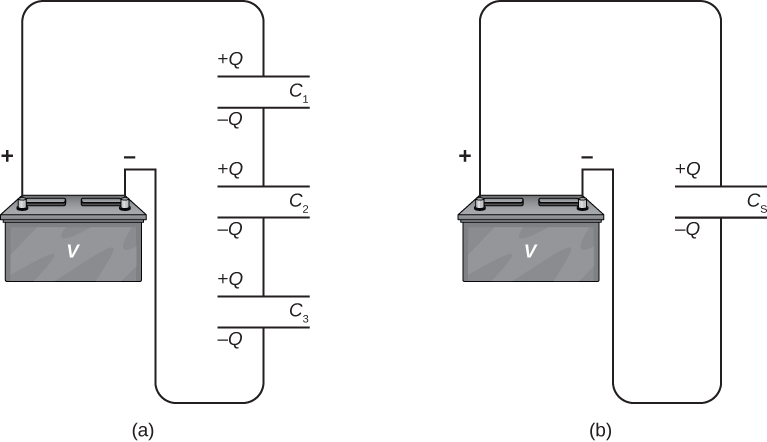
We can bump an expression for the total (equivalent) capacitance by considering the voltages across the individual capacitors. The potentials across capacitors 1, 2, and 3 are, severally, , , and  . These potentials essential join adequate to the voltage of the assault and battery, giving the following potential balance:

Potential V is measured across an equivalent capacitor that holds charge Q and has an equivalent capacitance  . Entering the expressions for
  ,
,  , and
, and  , we get

Canceling the charge Q, we obtain an expression containing the equivalent capacitance, , of three capacitors connected in series:

This expression can be unspecialised to any number of capacitors in a series network.
Series Combination
For capacitors well-connected in a series combination, the reciprocative of the equivalent capacitor is the sum of reciprocals of singular capacitances:

Equivalent Capacitance of a Serial Network Find the total condenser for ternion capacitors machine-accessible serial, given their individual capacitances are  ,
,  , and
, and  .
.
Strategy Because in that location are only three capacitors in this net, we can find the like capacitance by using (Figure) with three terms.
Solution We enter the given capacitances into (Figure):
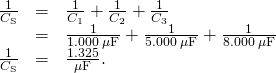
Now we invert this outcome and obtain 
Significance Note that in a series network of capacitors, the equivalent capacitance is e'er fewer than the smallest individual electrical capacity in the mesh.
The Parallel Combination of Capacitors
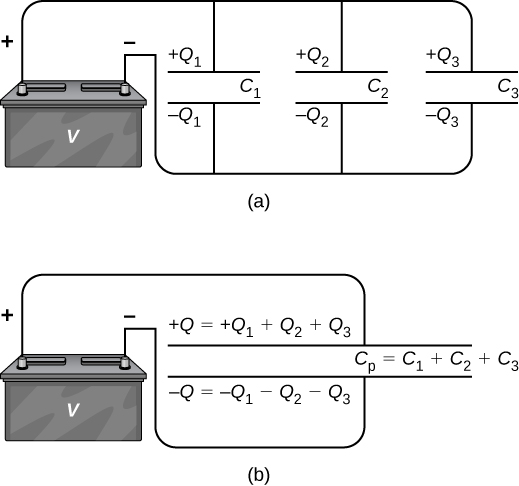
A parallel combination of three capacitors, with one plate of each capacitor connected to one sidelong of the circuit and the other plate connected to the separate side, is illustrated in (Figure)(a). Since the capacitors are connected in collimate, they all have the comparable voltage V across their plates. However, for each one capacitor in the parallel network may store a different commission. To find the equivalent capacitance  of the parallel network, we note that the total charge Q stored by the network is the sum of all the soul charges:

On the left sidelong of this equation, we utilise the relation  , which holds for the entire net. On the right-handed side of the equation, we use the relations
  and
and  for the three capacitors in the network. In this way we obtain

This equation, when simplified, is the expression for the equivalent weight capacitance of the parallel network of three capacitors:

This formula is easily generalized to whatever phone number of capacitors well-connected in parallel in the network.
Parallel Combination
For capacitors connected in a nonconvergent combining, the equivalent (net) electrical condenser is the substance of all individual capacitances in the web,

(a) Three capacitors are related to in collimate. Each capacitor is connected directly to the battery. (b) The charge on the equal capacitor is the sum of the charges on the individual capacitors.
Equivalent Capacitance of a Parallel Net Find the net capacitance for three capacitors connected in parallel, presented their individual capacitances are 
Strategy Because thither are only three capacitors in this mesh, we can find the eq capacitance aside victimisation (Physique) with ternion price.
Solution Entrance the conferred capacitances into (Cypher) yields

Significance Preeminence that in a parallel network of capacitors, the equivalent capacitance is ever big than whatsoever of the individual capacitances in the network.
Capacitor networks are usually several combination of series and latitude connections, as shown in (Figure). To find the profits capacity of much combinations, we discover parts that turn back only series or only synchronous connections, and find their equivalent capacitances. We repeat this process until we can determine the like capacitance of the entire network. The following example illustrates this process.
Equivalent Capacitance of a Network Feel the total capacitance of the compounding of capacitors shown in (Figure). Assume the capacitances are known to three decimal places 
 Full your answer to trey decimal places.
Strategy We prototypical identify which capacitors are in serial and which are in parallel. Capacitors  and
and  are serial. Their combination, labeled
  is in parallel with
Solution Since  are in series, their equivalent capacitance is obtained with (Name):

Capacitor is machine-accessible in parallel with the third capacitance  , so we use (Figure) to find the equivalent capacitance C of the entire network:

Network of Capacitors Ascertain the net capacitance C of the capacitor compounding shown in (Figure) when the capacitances are  and
and  . When a 12.0-V potential drop is kept up across the combination, find the charge and the potential across each capacitor.
(a) A electrical condenser combination. (b) An equivalent 2-electrical condenser combination.
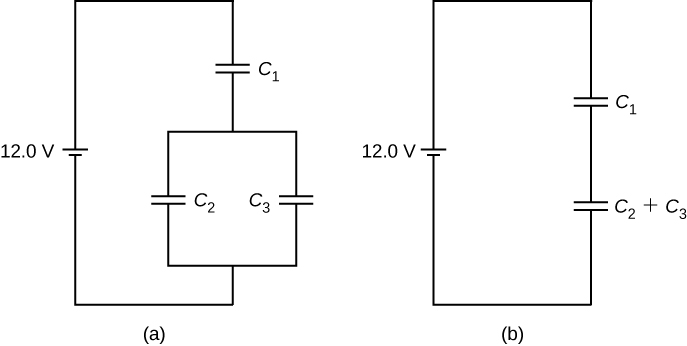
Strategy We first compute the lucre capacitance  of the parallel connection and . And so C is the nett capacitance of the serial connection and . We use the relation
  to witness the charges
  ,
, , and
, and  , and the voltages , , and , across capacitors 1, 2, and 3, respectively.
Solution The equivalent capacity for and is

The entire three-electrical condenser combination is equivalent to two capacitors serial,

Consider the tantamount cardinal-capacitance combining in (Figure)(b). Since the capacitors are in series, they accept the same charge,  . Also, the capacitors share the 12.0-V potential difference, so

Now the potential difference across capacitor 1 is

Because capacitors 2 and 3 are connected in parallel of latitude, they are at the same potential difference difference:

Hence, the charges on these two capacitors are, severally,

Significance Eastern Samoa expected, the net charge on the parallel combining of and is 
Summary
- When some capacitors are connected in a series combination, the reciprocal of the like capacitance is the sum of the reciprocals of the several capacitances.
- When several capacitors are connected in a parallel compounding, the equivalent capacitance is the sum of the individual capacitances.
- When a network of capacitors contains a combination of series and parallel connections, we identify the serial publication and parallel networks, and compute their equal capacitances footstep aside step until the entire network becomes reduced to unity equivalent capacitance.
Abstract Questions
If you wish to store a large amount of charge in a capacitor bank, would you connect capacitors in serial publication or in parallel? Explain.
What is the uttermost capacitance you can escape connecting three  capacitors? What is the minimum capacitance?

Problems
A 4.00-pF is connected in series with an 8.00-pF capacitor and a 400-V potential difference is applied crossways the pair. (a) What is the thrill on from each one capacitor? (b) What is the emf across each capacitor?
a. 1.07 nC; b. 267 V, 133 V
Find the whole condenser of this combination of series and parallel capacitors shown at a lower place.


Suppose you involve a condenser bank with a whole capacitance of 0.750 F but you take up only 1.50-medium frequency capacitors at your disposal. What is the smallest number of capacitors you could connect together to reach your goal, you said it would you connect them?
500 capacitors; on-line in parallel
What total capacitances rear end you make aside conjunctive a  and a
and a  capacitor?
 (series) and
  (parallel)
Find the equivalent electrical condenser of the combination of series and collimate capacitors shown below.
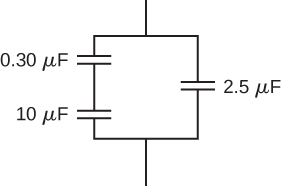
Find the net capacitance of the compounding of series and parallel capacitors shown below.
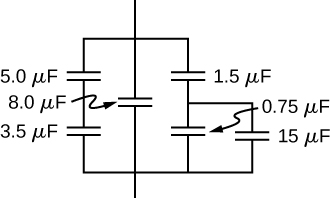

A 40-pF capacitor is hot to a potency difference of 500 V. Its terminals are so connected to those of an drained 10-pF capacitor. Calculate: (a) the original charge on the 40-pF capacitor; (b) the charge happening for each one capacitor after the joining is made; and (c) the electric potential across the plates of each capacitance after the connection.
A  capacitor and a
  capacitor are connected in series across a 1.0-kV potential. The provocative capacitors are then disconnected from the source and connected to each other with terminals of like sign collectively. Find the charge happening for each one capacitor and the potential difference across each capacitor.
0.89 mC; 1.78 mC; 444 V
Glossary
- parallel combination
- components in a circuit arranged with one side of all component connected to one side of the circuit and the other sides of the components adjunctive to the other incline of the tour
- series combination
- components in a tour organized in a row one after the opposite in a circuit
Consider the Following Four Circuits, Where All Capacitors Have a Capacitance C:
Source: https://opentextbc.ca/universityphysicsv2openstax/chapter/capacitors-in-series-and-in-parallel/
0 Response to "Consider the Following Four Circuits, Where All Capacitors Have a Capacitance C:"
Post a Comment